Saturday, October 11, 2014

Techies Vs. Actors


If you hang around with the theater technicians (or “Techies”, as they’re affectionately referred to) long enough, you’re bound to hear the following quote by Mark Leslie:  "An actor without techies is a naked person standing in the dark trying to emote. A techie without actors is a person with marketable skills."  While this statement is dripping with sardonicism, there certainly is some truth to its premise.  While they usually stay behind the spotlight instead of in it, techies are accomplished artists and craftsmen, and they play a huge role in making sure any given show is a success.
 

As Mr. Leslie’s quote suggests, there is often some friction between the actors and the techies in most shows.  As someone who has lived on both sides of the duvetine curtain, I can tell you that there is nothing more frustrating than a lighting designer who keeps fluctuating the lights while you’re trying to rehearse, or an actor who’s so busy warming up for his performance that he can’t sit still for a mic check.  While such minor irritations may seem petty, they can build and cause a stressful working environment for everyone which is unhealthy not just for the cast and crew, but for the show as well.
However, despite the animosity that does exist, most shows I’ve been a part of have always been full of mutual respect.  While one will occasionally hear playful sparring between the “board geeks” and “bio props” passing in the wings, the archetype of the diva performer and the unsympathetic techie is rarely actually encountered.  Regardless of what side of the stage you sit on, if you work at the theater, you’re an artist and this knowledge obliges and compels every thespian, actor and techie alike, to grant their fellow artist the respect they deserve.


As is the way in all things, it’s hard to give somebody the respect they deserve if you don’t realize just how difficult their work is.  That's one of the things I really like about the theater program at my school (University of Alabama).  All theater majors, performance and technical alike, are required to take both acting classes and technical classes.  While such classes are not strangers to bitter grumbles of “why do I have to be here?” and “This has nothing to do with my future career.”  In short, they couldn’t be more wrong.

For one thing, just learning the terminology alone is extremely useful for creating a healthy flow of communication.  This is critical because theater, its core, is all about communication.  However, you have no hope of communicating your story to the audience if you can’t even communicate with the people you’re working with to bring that story to life.


This theatrical cross-training also serves to introduce students to a side of theater, yet undiscovered, that they thoroughly enjoy.  I know that I stepped onto campus fully intending to act my way through school, but have since answered the call of technical theater.  The adrenaline rush of a performance, the challenge of out-of-the-box thinking, the feeling of familial love that engulfs a cast, all of these things that I thought I could experience solely through acting, I’ve found to be just as present, if not more so, by being a techie.


What’s more, knowing “how the other half thinks” can do nothing but make you more proficient in your own craft.  An actor who knows the intricacies of costume design may unlock new aspects of his character by studying the costume he’s given, a prop designer may better know where to sacrifice realism for ease of use if she’s had to wield them herself, and lord knows we could all learn something from a course in directing.


But most of all, understanding breeds respect, and that is what every theatrical artist deserves.  In fact, I think Mr. Leslie’s quote could use some editing.  For while it is true that techie’s are able to create some beautiful pieces of art without the need of human actors, there are also some incredible masterpieces that have no sets, no costumes, no tech of any kind, but soar on talented acting and raw, sincere material.  However, my experience has shown that nothing can rival the magic created when of their synergy.  So in fact, I think the correct version of Mr. Leslie’s statement is “An actor without techies is the same as a techie without actors: an artist who is not reaching his full potential.

That musical was great...but the movie came first!


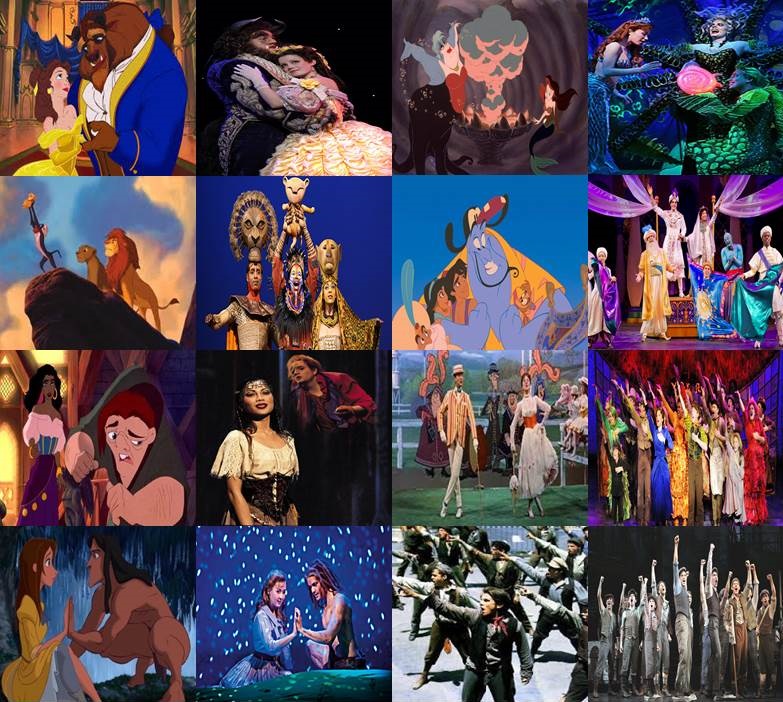
For those of you who read my last post concerning musicals that have been turned into movies, I present to you the thrilling conclusion: Movies that have been turned into musicals.  That’s right, the door swings both ways and while Broadway’s best have been filling the silver screen, cinematic classics have been working their way through the boards on Broadway as well.   However, unlike the previous post, I’m not going to spend the pixels to explain to you the history of the screen-to-stage adaptation, but instead try to answer the question: What kind of movie lends itself to Broadway.  This question is much harder to answer because, at first glance, there seems to be no one ingredient to be found in every adaptive Broadway smash.


One common assumption is that a successful movie would make for a successful musical.  This, a very logical assumption, is quite true in several cases.  Indeed many blockbuster movies such as Mary Poppins and Leagally Blonde have earned similar critical and commercial success on the stage as they did on screen.  However, on the whole, my observation shows that it is actually the less successful movies whose musical adaptations tend to flourish.  Low budget films like Little Shop of Horrors and Newsies have found incredible success on stage whereas the adaptations of many of their more critically acclaimed counterparts such as Ghost and Big Fish fizzled.

Another logical assumption is that musical movies that are prime candidates for theater adaptations.  If a movie already has a winning soundtrack, then why wouldn’t it be able to seamlessly transition onto the stage?  This theory seems to me to have been proven true by Academy Award winning scores such as those of The Lion King and Aladdin that went on to become equally successful on the Great White Way.  Of course, I often find that these musical masterpieces prove most effective when they’re complemented with re-orchestrations and original songs.  In the case of the previous two shows, songs that never appeared in the movie incarnations, such as The Lion King’s “Endless Night” and Aladdin’s “Proud of Your Boy”, serve as some of the stage version’s strongest moments.

So is there one particular genre (other than musicals) that make a good Broadway transfer?  Well, Broadway certainly accepts all types.  Documentaries (Hands on a Hard Body), Horror Movies (Carrie), and Action films (Rocky) have all found homes on the Broadway stage.  However, despite all of this diversity, there are a few genres that seem to be more prevalent:

Romance movies are a popular choice, as is proven by films such as Once and The Bridges of Madison County that became successful musicals in the past several years.  I expect that this is largely because the love song has for years been one of Broadway’s most beloved tools, and what better showcase for a beautiful duet than a beautiful love story?

Broadway has also welcomed several shows based off of laugh out loud comedies such as Mel Brooks’ Young Frankenstein and Monty Python and the Holy Grail.  This brand of entertainment has become so popular in theater because the larger-than-life characters in such movies seamlessly transfer to the stage and the audience comes to the theater fully prepared to suspend their disbelief (often a necessity for enjoying stage shows).

But by far, the most common movie genre that I’ve seen find success on the Great White Way is family friendly entertainment.  This is somewhat ironic because I would call the majority of successful Broadway musicals in general to be “PG-13 at best,” but apparently that rule doesn’t hold true to adaptations.  Whether you look to holiday classics like A Christmas Story and Elf, animated masterpieces like Beauty and the Beast and Shrek, or childhood favorites such as Chitty Chitty Bang Bang and Matilda, PG-rated movies have quite a successful reputation on New York Stages.  While I can’t say with any degree of certainty why children’s movies seem to be such successful choices when it comes to stage adaptations, I expect a large portion of it is that parents don’t necessarily want to take a chance on anything new when they take their child to the theater.  If there’s a movie that the kids already know and trust, then why not see those characters come to life in a fun, safe environment?

Now that I think about it, there’s one more component that a surprising number of successful screen-to-stage adaptations seem to share: Walt Disney.  From Beauty and the Beast to Aladdin and everything in between, it seems Disney Theatrical Productions can do no wrong in their adaptations.  With a record like there’s, it’s no wonder that they have several more shows – including The Jungle Book and The Hunchback of Notre Dame –already in development.

So while any and all types of movies can be made into musical, if you want to have the best chance of success, I suggest choose an obscure children’s’ movie that already has a great soundtrack, and if it happened to be written by Disney, then that wouldn’t hurt.

Thursday, October 2, 2014

That movie was great...but the musical came first!


In 1927, Warner Brothers Studios released The Jazz Singer, the first ever feature length film with synchronized sound, heralding the end of the silent film era and opening the door to a new age, the age of the “talkies.”  However, The Jazz Singer was more than just the first audible movie to be released, it was also the first musical movie.

 Indeed as long as there has been movies as we know it, musicals have been right there with their tap shoe in the door, and wherever there are musicals, Broadway can’t be far behind.  The intricate dance between Broadway and cinema has been a true Hollywood style love-hate relationship if ever there was one.
 
To be sure, making a movie out of a Broadway smash sounds like the perfect symbiotic relationship.  The filmmakers gets a story that they know audiences will love, most of the writing and creative work is already done for them, and they have a built in audience before the movie even hits the theaters.  On the other side, Broadway artists get to make their show ten times larger and yet still more detailed and intricate than the stage could ever allow.  What’s more, the musical movie also solves the biggest tragedy of live theater: its terrible fleetingness.  Through the magic of the silver screen, Broadway’s best stories are immortalized for all eternity and the happy viewers can watch these masterpieces whenever they want, as often as they want.

The stage-to-screen transition seemed to be the perfect fit, and for the longest time, audiences were devouring every glorious note.  Broadway adaptations such as “My Fair Lady,” “The Sound of Music,” and “West Side Story” achieved enormous success both with the critics and the box-office.  Then all of a sudden, they seemed to stop.  I don’t know who decided it, but it seems the film community decided that musicals were too campy/unrealistic and the theater begin to balk at screen adaptations for fear of the destruction of the story they built.  And I’m afraid these fears were somewhat justified.  As the film industry has progressed, they’ve worked on becoming more true to real life, and let’s face it, real life isn’t a strength of a Broadway Musical.  In a world of High Definition pictures and realistic special effects, big production numbers and musical dialogue just didn’t seem to fit, and so movie movie-musicals fizzled and screens went tuneless for a season.

Thankfully, that all changed when “Chicago” won the 2002 Academy Award for Best Picture.  “Chicago” reminded the world how much of a role fantasy plays in real life and, what’s more, reminded them how beautiful a stage-to-screen collaboration could be.  It wasn’t long before major production companies caught the idea, and within 5 years we were given screen adaptations of some of the best musicals ever made including “The Phantom of the Opera,” “The Producers,” and “Hairspray.”  And with the great success of “Les Miserables” in 2012, it seems that movie musicals are here to stay.  In fact, 3 Tony Award winning musicals, including the star-studded “Into the Woods” and reimagined “Annie”, sang their way to the silver screen in 2014, and more have been promised.

While I wholeheartedly believe that a camera can never fully capture the magic of live theater, I still love the idea of the movie musical.  For while it’s a mere taste of the real thing, sometimes it’s the only taste a poor college student in the south east can get without plane tickets and a time machine.